my blog

Posts Tagged ‘Washington D.C.’

Honoring the stories of 9/11

My reflections on the anniversary of 9/11 feel trivial in comparison to those of people who were there – at the World Trade Center, the Pentagon, in New York or Washington, D.C., on the planes or any plane once the news broke … and of course the thousands of lives lost and the broken-hearted they left behind. I’m sure 25 years has not made the anguish of those memories any less painful for those who experienced terror, despair or worked tirelessly to help.
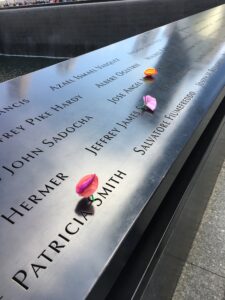
Close-up photos of names at the 9/11 Memorial, with flowers left on some names in remembrance.All I know is that my own heart breaks every year, and this anniversary is no different. Except this year, the stories are more prominent, more visible – and ultimately more intensified rather than softened with the passage of time.

Again, my story is a small one, far removed from the actual events. Everyone has a story, and I strongly urge you to seek out the stories of the survivors, the helpers and the grieving who were personally impacted by that day. People are posting them online, sharing what they lived through, remembering loved ones they lost, describing what it was like being there on that day. Those are the stories to lift up. It’s not hard to find them and I hope you will. But sharing my own story is my way of honoring their experiences.

I was initially oblivious that day, or at least I thought I was. I was in the midst of morning meditation when a friend who had recently passed away crossed my mind. Suddenly, I began to cry. These things happen in meditation, so I didn’t think much of it. But when I finished my meditation the phone rang and a friend told me a plane had hit the World Trade Center. I said, “What a terrible accident! How very sad. I hope people in the building got out.” At first most of us assumed it was a terrible accident, but we quickly learned it was an intentional act when the second plane hit.

What’s notable about my tears during meditation is that, when I looked back, I realized I began to cry at the same time the first plane hit. I’m not saying I have any sort of special abilities. But I do believe in the power of the universe and I am convinced I felt the immense shift in energy that came to engulf the entire world – not just that day or that week, but undoubtedly forever. America and the world will never be the same.

It’s a little embarrassing to admit that because I didn’t turn on the TV right away and was only watching reports online, at first I didn’t fully grasp just how devastating it all was. Of course, I later turned on the TV and saw the buildings tumbling down, the people in the streets running from the debris – covered in dust from the rubble and destruction, literally coating their bodies in the powder of everything the buildings’ collapse blew into the air. I’ve since learned from those who lived in New York that the smell of that airborne dust lingered for days, if not weeks.

As the day went on, the stories of heroism and kindness slowly began to emerge in the midst of the horror, probably because as humans we needed some hope. I experienced some of them myself. A friend who had never said “I love you” said it that day, fearing the building he worked in could be a target. People from around the world checked in on each other. When it became clear that none of us would do any work the rest of the day, I went into town to run an errand. Silly, when I look back, but I didn’t know what else to do with myself. At that point we still didn’t know exactly what had happened, but I knew I could not watch the TV any longer.

Walking through the deserted downtown of my small city, the few people I encountered were in a daze, like I was. The woman at the store I stopped in was quiet but warm. I bought my item but then stood there and talked with her for a good 30 minutes. I think we just needed to connect with another person, at any level. We all felt lost. And we knew the losses were only beginning.

Photo of the 9/11 Memorial, with people's names etched in metal in the foreground, and the pool with the "footprint" of one of the towers behind it, and the buildings of the city behind that.I’d had plans for that evening but I canceled them. I didn’t have the heart to go out to dinner for the birthday I had coming up. It just didn’t seem right. So I stayed home and returned to the TV, trying to make sense of what had happened, which I still haven’t been able to do, despite knowing the facts, all these years later.

As I said, my reflections seem insignificant compared to those of people who were directly affected. But then again, we have all been touched by what happened – even people who weren’t born yet have been, because the world changed forever that day, and I don’t just mean things like airport security. We are now more painfully aware than we were before of the depths of hate that some people feel and will act on.

I want to be very, very clear: What happened that day was not caused by all Muslims, and I never once blamed anyone who wasn’t a perpetrator of the brutal attack that day. It’s a lesson many people still haven’t learned, so my heart goes out to innocent Muslims as much as it does to the victims and their loved ones.

Although I will never forget the horror, I try to remember the helpers – just like Mister Rogers said we should do in times like these. The first responders, many who came in on their days off and others who traveled from around the country to help. The New Yorkers far enough from Ground Zero who offered shelter to people displaced from their homes in those first days. In particular, I think of the people of Gander, Newfoundland, and other places in Canada, who took in thousands of passengers whose planes were forced to land there when the U.S. airspace closed. The story of Gander is told in the musical Come From Away, which shines a light on the enormous kindness that was extended there in response to a devastating tragedy.

Come From Away reminds us that no matter how deeply terrible the world can be, there are always good-hearted people … and there is always hope. There are countless productions of the show being presented around the country right now, and a filmed production of the original Broadway cast is on Apple TV+. If you haven’t seen it, I urge you to do so as a comforting reminder of all the good that can come when we work together instead of against each other.
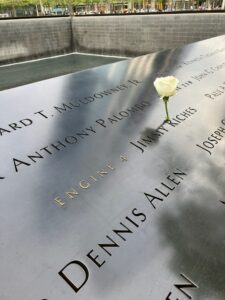
Photo of the 9/11 Memorial, with names etched in metal with a single flower left for someone, with the waterfalls and pools of the Memorial in the background.I will never forget that day or the people who suffered – nor the goodness that rose from the literal ashes. I will always honor it in my heart, even though I do it through tears every single year.

As I said from the start, my story is a very small one compared to the stories of those who lived through that day in some way, and I dearly hope you will seek out their recollections. Those are the stories that matter most, even though anyone who was alive that day has a story, and they’re all valid.

May those who are hurting find peace in whatever way they can. And may we all try to be just a little kinder, a little more helpful, a little more understanding of each other, finding our commonalities rather than looking for differences. We are all in this world together, and there is far more good than there is bad, if we are willing to look for it. Even more important, each of us can do our part to bring more goodness into the world and our communities, in ways large and small.

Photos by Amy Lynn Smith.
Love and politics

I grew up in what you could call a two-party home. It wasn’t that one parent was necessarily a staunch Republican and the other a die-hard Democrat. They often switched sides so, really, they were independents. But they almost always canceled out each other’s votes and had lively debates (translation: arguments) about the issues.

Here’s one thing they agreed on, though, and it’s the principle that’s really stuck with me: You don’t vote for the party. You vote for the candidate whose values you support. You vote for whoever you think is the best person for the job.

This hasn’t only informed my voting decisions. It’s shaped my view of how our government works, about how our leaders should work together, about what’s possible when people put aside their differences and work for the common good.

Love and politics

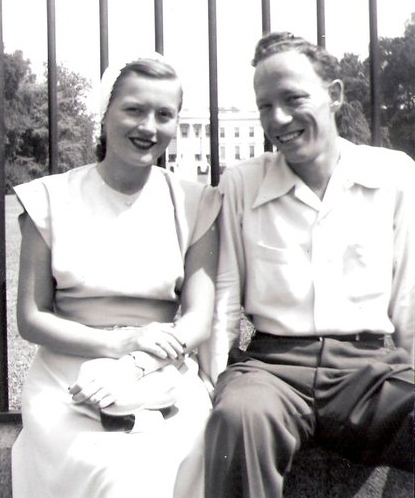
My parents visiting Washington, D.C., on their honeymoon.

When you get right down to it, marriages and politics aren’t really all that different. There are negotiations. There are disagreements. There are good times and bad. There are issues where you’ll find common ground and others that will be a point of contention. There are days when you won’t even feel like speaking to each other and other days when your unity is the only thing that matters. In the end, though, a good marriage remains strong because for all the arguments or conflicts or grievances, you’re part of something bigger. The common good — the love you share, the vows you’ve taken, the family you’ve created — is more important than who left the cap off the toothpaste.

I firmly believe the same is true in politics. I think most people who run for office do it because they want to make a commitment to something bigger than themselves: their community, their country, their corner of the world. They want to serve with others who believe that our world can be a better place when we work together instead of against each other.

This is why I believe in the power of bipartisanship. Our country has been divided at times, as it certainly is today, but it has always managed to come back together. Good people have put country before party and worked together to create compromise, to solve problems and find solutions that unite us and make us stronger as a result.

Love and politics

Me, 64 years after my parents’ honeymoon.

We have a lot of work to do, it’s true. And it begins with each of us, with the desire to put petty partisanship aside and remember that we are stronger together. We have to be willing to accept each other’s differences, to live and let live in a country where everyone has the freedom to choose their destiny.

If every single citizen agreed to stop fighting about ideological differences and searched for common ground, that groundswell could eventually reach our leaders. We can tell them how we feel by writing letters, making phone calls or gathering peacefully outside their offices. We can tell them how we feel with our votes, by electing people who will work together instead of against each other.

It starts with each of us. My parents taught me that you don’t always have to agree to love each other or work as a team. Disagreements can be part of eventually reaching a compromise. You can have strong convictions and you don’t have to give them up. But sometimes, you have to concede just a bit. You can hold fast to your personal beliefs without imposing them on others.

If our leaders truly love our country — which should be the only reason they run for office in the first place — then they should put it ahead of everything else, and work together to find solutions that make our country stronger.

Because if we don’t move forward together, we’ll never get anywhere.

~

I wrote this as I prepared to attend the Meeting to Make America Work! hosted by No Labels, an organization founded to foster bipartisan problem-solving in Washington. 

With tolerance and justice for all

Tolerance. Justice. Diversity. Equality. These are principles I’ve been thinking about a lot lately.

And they’ve become indelibly stuck in my head, it seems, by the musical Parade. The show tells a tale of intolerance and injustice in the Deep South of the early 20th century, a story that’s still being played out around the country.

With tolerance and justice for allI saw Parade more than a month ago, at Ford’s Theatre in Washington, D.C. The production was superb, and the show (book by Alfred Uhry; music and lyrics by Jason Robert Brown) is powerful both in music and message. Parade is based on the true story of Leo Frank, a Northern Jew living in Atlanta, who in 1913 was unjustly accused of murdering a young girl. You can read more about Frank and Parade, but if you have the chance to see the play I urge you to do so with no prior knowledge, as I did. I was deeply moved and stunned by the story.

I will share that Parade explores issues of the intense pride of the Deep South, particularly after the Civil War, and how that loyalty sometimes becomes bigotry. It looks at the ways justice can be derailed for political gain or hatred of someone who doesn’t fit in, whether that person is African American, Jewish or simply different. It also eloquently expresses that everyone has a point of view, and rarely is that view either all good or all bad. And that despite the inclination of some to go along with a group mentality, there will always be those who follow their own conscience. That there are people who will do the right thing, no matter what it costs them.

The performance was followed by a talk with members of the production team and the audience. Parade was part of an ongoing endeavor at Ford’s Theatre called the Lincoln Legacy Project, “a five-year effort to create a dialogue in our nation’s capital around the issues of tolerance, equality and acceptance.”

Audience members shared their thoughts on how the story paralleled current events like the Troy Davis execution, which had happened that week. Others mentioned Alabama and its immigration laws, or attendees at a GOP debate booing a soldier for being gay. Still others talked about how the media can shape the public’s thought powerfully enough to influence a legal verdict.

One woman was extremely angry. She demanded to know why Ford’s Theatre had put on a play that, as she put it, made her “hate the South.” She couldn’t understand why a theatre would present a play that portrayed the South as so evil, that would add fuel to the fires of hatred already so prevalent.

The director of the theatre came out to answer the woman’s questions. He explained that everything in the play is true, and that the production team felt the play had an important message to convey. Although bigotry may be directed at different groups today than it was 100 years ago, it still exists.

I could see exactly where he was coming from, because the play raises timeless issues of intolerance and injustice. What’s more, I disagreed with the woman’s viewpoint. Partly because some of the negatives Parade portrays about the Deep South were, and are, sometimes true. But even more important, the play’s characters include Southerners who accepted diversity and who did the right thing, in one case risking a potentially important career. The play shows that no matter what side people were on — that of a beloved young girl who was mysteriously murdered or the man who swore he’d never touched her — everyone suffered a loss. Everyone was seeking justice. My heart ached for everyone.

All of this has stuck with me for a month, as I’ve listened to the music and continued following the news about events in the Deep South. Alabama, in particular, troubles me. I realize our country has an immigration problem, but I’m certainly not alone in questioning the severity of the law they’ve passed there. A recent article even compared the immigration fight in Alabama to the civil rights era. Meanwhile, some Alabama state legislators have used racial epithets while others have faced charges in a gambling corruption trial.

All this and more paints an ugly picture. It makes me angry. It makes me wonder how any state could have so much disrespect for its citizens. I realize I don’t know every detail, but it still upsets me. It also worries people I’ve spoken to who live there or were raised there. One man in particular dislikes going back because of what the state has become, but still urged me to read a book that celebrates the good things about Alabama (Alabama Afternoons by Roy Hoffman). It’s on my to-read list. I appreciate his balanced view.

Because while I reflect on the questions that continue to roll around my head, many still unanswered, I can’t stop thinking of the two ladies from Alabama I sat next to at the “Capitol Steps” during that same trip to D.C. Incredibly nice people, who laughed as much at the satirical group’s pot-shots at one political party as they did at those taken against the other. I did the same. And to me, bipartisan humor indicates a bipartisan perspective.

Those ladies were a lovely reminder that not everyone in Alabama, or anywhere else for that matter, thinks the same way. Which brings me back to one of my fundamental beliefs: No group is all good or all bad. No person, with rare exceptions, is all good or all bad. Does some of what’s happening in Alabama and other states — Southern and otherwise — make me worry for the future of tolerance and justice in this country? Absolutely.

But even more important, I believe that in the midst of hatred and bigotry and lies, there are people fighting for positive change. Just as there were in Parade and the tragic true story of Leo Frank, there are people everywhere trying to do the right thing.

I believe in the good in people, and I believe that the good in people will ultimately prevail. Even if every story doesn’t have a happy ending.