

As I reflect on the milestone of earning my master’s degree, I’ve been asking myself: “How will you use what you know?”
 After receiving my Master of Arts in Mass Communication with a specialization in Public Interest Communication from the University of Florida — which I’m proud to say awarded me Graduation with Distinction honors — those words written by Wendy Wasserstein for her play The Heidi Chronicles keep rolling around in my head. Others are asking me similar questions: “What’s next?” “What did you learn?” “How has earning your degree changed how you approach your work?”
That last question is as intriguing as Wasserstein’s. And it led me to remember another line from The Heidi Chronicles, in which I played Heidi many years ago: “All people deserve to fulfill their potential.” I could not agree more — and it’s a good way to describe my intention for how I will use what I know.
This isn’t to say I wasn’t fulfilling my potential. I already specialized in Public Interest Communication for clients doing meaningful work, such as the United Nations, the American Foundation for the Blind, Spitfire Strategies, the W.K. Kellogg Foundation and many more over the years. As one colleague and friend told me, “You’re a Swiss Army knife,” which was his creative way of saying I am a highly versatile communicator. My work includes strategic storytelling, messaging strategy and execution, content creation such as blog posts and human-interest profiles, issue campaign development and delivery, writing and speaker coaching, editing and more.
I enrolled in the Public Interest Communication program’s inaugural semester in 2019 and it took me until 2023 to earn my degree. Because I work full time as a consultant, I mostly took one course per semester. I learned that many other returning students did the same. And I discovered that my years of professional and personal experience enriched my learning.
Without question, the program expanded my expertise. I not only learned more about topics I’m familiar with, such as storytelling and creating an issue advocacy campaign. I also dove into new realms I’d heard about, such as value propositions and design thinking, but had never explored. Particularly in the latter course, I learned a great deal about myself, too.
Because of that course, I now ask myself periodically, “How’s it going?” It’s a strategy taken from the book Designing Your Life: How to Build a Well-Lived, Joyful Life that was engagingly taught, and I still periodically check in on my life. Is it going in the direction I want it to? Am I spending more time on things I love and less time on things I don’t? The answer is generally yes. And when it’s not, I pause to redesign my life accordingly.
It’s intriguing that the willingness to change course in my own life — to try something new, to ditch something old or improve on it — is also serving my work and my clients well. Of course, I now have master’s-level abilities in my field. But the way my work has transformed is about more than simply sharpening my skills.
I look at my work differently now. I recognize opportunities to recommend unique or better approaches. I use my diverse creative skills to imagine and create more impactful communications. I’m exploring new ways to work, not just with my clients but in collaboration with colleagues. I’m discovering how to be more efficient and productive. I still work hard — perhaps even harder sometimes, because jobs that use my thought leadership skills are more complex — but I’m definitely working smarter.
I was already fulfilling my potential. But as I move forward after graduation I know that potential is greater than it was. I can — and am eager to — raise the level of the potential I intend to fulfill. That means stretching myself, accepting sometimes daunting challenges and meeting them. That means saying “yes” to projects that feed my soul and, whenever possible, saying “no” to those that don’t.
Most important, I’m more inspired than ever to make a difference in the world — to make sure everyone has an opportunity to thrive. After all, everyone deserves to fulfill their potential. And doing everything I can to make that possible for myself and others is the answer to the big question: How will you use what you know?
As a storyteller, I thrive on helping people tell their stories — and that work is not confined to the written word. I embrace every opportunity to provide speaker coaching services, because it means helping people present the best version of themselves and the stories they want and need to tell.
Although I offer this service for a fee, I sometimes do it purely for the love of speaker coaching. Not only does it apply my extensive communication and storytelling skills, it gives me a chance to flex my muscles in theatrical directing, which I did for many years.
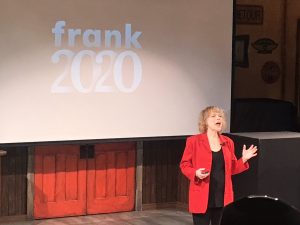 Of course, presenting public remarks isn’t quite the same as playing a role onstage. Speakers are putting themselves out there, with no character to hide behind. So it’s no wonder that some people are terrified of public speaking. Heck, even after decades of acting and public speaking I still get nervous before I go onstage. But there’s really nothing to fear, especially if you have a speaker coach to offer tips and insights that help you shape your presentation. When I presented a talk at the 2020 frank gathering of public interest communicators, I was grateful for input from fellow coaches and theatre friends. (You can find some of my other public speaking appearances here.)
Early on, I had a coach who encouraged my public speaking, and my coaching style is informed both by what I learned from the late, great Joel Silberman and my theatrical experience. Every speaker coach has their own approach — and every speaker deserves coaching tailored to their unique needs. I’ve worked with people who have never given a public talk, people who have given TED Talks before I worked with them and everything in between. I meet each speaker where they are, and there’s no end to the kinds of advice that can be helpful to any given speaker. Perhaps they need tips on stage presence or simply the confidence that what they’re doing is really good, although even the best talk can be sharpened by a fresh perspective. Or maybe they need help shaping and refining their content and slides. Like any good story, a public talk should have a beginning, middle and end, and it should draw the audience into the speaker’s world.
I’m proud to have served as lead speaker coach for the frank gathering for so many years I’ve lost count. That role means not only coaching some of the speakers but also offering logistical and coaching advice to my esteemed fellow coaches. That’s work I do almost entirely for the love of speaker coaching (and frank), as a pro bono service. At the 2023 gathering, I also had the pleasure of presenting a workshop entitled, “Get Ready for Your Next Public Speaking Engagement.” I was honored that fellow frank speaker coaches Mark Dessauer and Iman Zawahry joined me.
 We began by sharing our own favorite tips for public speaking, and I learned from hearing how they work with speakers. In addition to my tips — let your true self shine and trust yourself; be confident — their tips reinforced the importance of structuring your talk for the greatest impact (there’s storytelling again), engaging with your audience and, whenever possible, including a personal story.
Then we broke into three groups and gave individual coaching to people who brought a talk they were working on. In my case, one participant had a piece that was already beautifully written and nicely presented. But there’s always room for improvement. It’s hard to describe the satisfaction that comes from offering some concrete suggestions (after giving kudos for what’s working well), seeing the “lightbulb moment” in a speaker’s eyes — and then watching them take that input and soar. This participant only needed some minor tweaks: consider pausing here, or emphasizing that word, or showing us more emotion in this section. Every time she rehearsed her short piece again, it got better and better.
It’s always a thrill to coach speakers at frank and others I’ve worked with, and although speaker coaches never tell who they’ve coached, I am grateful for the speakers who have publicly thanked me for my efforts. But I always remind speakers that it’s really all them. They are the ones with an idea they’re passionate enough about to present in front of an audience, and they are the ones who step into the spotlight to share their thoughts.
The way I look at it, I’m there to help them be the best possible version of themselves, offering whatever guidance I think they need and want to hear.
Interested in my speaker coaching services? Please contact me and let’s talk!
Photo credits: Top image unknown; bottom image Anne Savage Photography.
As I head to the frank gathering at the University of Florida, I have many reasons to reflect on learning.
 Of course, there’s frank — “the gathering for people who change the world” — which I’ve attended for nine of its 10 years. Within my first day there nine years ago, I knew I’d found my tribe: people who are actively engaged in catalyzing significant social change. It’s work I’d been doing but wanted to do more of, and I soaked in every moment of the brilliant speakers, breakout sessions and opportunities to talk with people at all levels of the field of public interest communications.
Over the years, I’ve been increasingly involved behind the scenes at frank. At times, I’ve served on the steering committee and reviewed research prize submissions, but my most consistent and beloved contribution is being a speaker coach and, for a number of years, the gathering’s lead speaker coach.
As a speaker coach, I draw on decades of directing theatre and being a public speaker myself. I thrive on helping speakers shine onstage, but I greatly value what I’ve learned from every speaker I’ve coached. They’ve taught me fascinating things about the work they do, and the other lessons I’ve learned have been myriad, from helping someone overcome stage fright to knowing when to step back and trust a speaker’s expertise.
But my learning at UF doesn’t end with frank. That’s where I discovered the university’s online master’s degree program in Public Interest Communications. I’m graduating in summer 2023, and my experience returning to school after 30 years has been immensely gratifying. I already work in public interest communications, helping nonprofits, foundations and campaigns tell the stories of their work in a way that motivates others to act. But even when I took the required course in storytelling — my primary area of expertise — I intentionally brought an open mind and found there is always more to learn.
In every class, I’ve sharpened my skills and absorbed new ideas and insights from both my instructors and my fellow classmates. Part of the program’s appeal is that it attracts people of all ages from all over the world, making it a wonderfully diverse learning experience. And much like speaker coaching, the learning can be a two-way street. I was honored when I learned that a story I wrote for UNHCR (the UN Refugee Agency)’s Innovation Service was on the syllabus for the Introduction to Public Interest Communications class.
Although I look forward to holding my diploma in my hands, I’ve been applying what I learn to my work after each semester. I’ve brought new ideas to my clients, inspired them to create value propositions, developed campaigns based on their goals that they can use if they wish — and sometimes, I’ve learned to think differently about how I approach my own work. I’m eager to bring all my knowledge to comprehensive campaigns in my ongoing mission to create great content for the greater good.
I have some idea about what I’ll learn at frank 2023. But there’s quite a bit I don’t know and I can’t wait for the delightful surprises frank always brings forth. I’ll spend the week there with an open mind that’s ready to absorb as much as my brain will hold — and there’s absolutely no question that I will learn something new every day.
Photo by LAF Lines Photography.


